
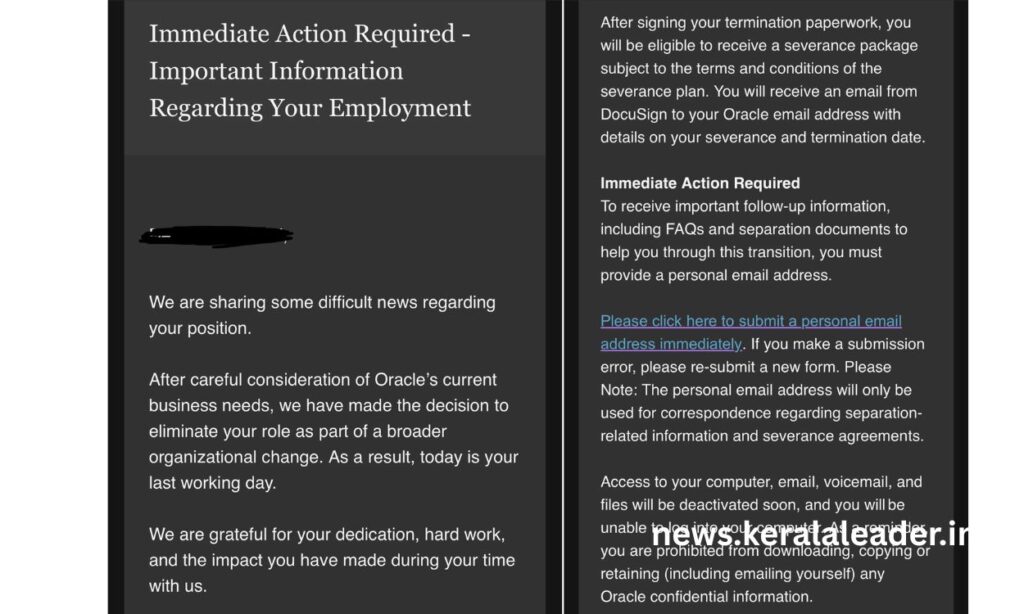
For scores of Oracle staff members, the working day opened not with standard scrum calls or project roadmaps, but with an unsparing notification waiting in their inboxes. Dispatched around 6:00 AM, the corporate termination memo arrived with swift finality: “We are sharing some difficult news regarding your position… Today is your last working day.”
The early-morning cull—executed with immediate digital account deactivations spanning email, internal files, and team chat channels—underscores a brutal reality playing out across enterprise computing: legacy payrolls are shrinking so balance sheets can absorb unprecedented investments in artificial intelligence infrastructure.
The Balancing Act: $95 Billion CapEx Meets Negative Free Cash Flow
Oracle’s job cuts arrive alongside an astonishing deployment of corporate capital. The database and cloud behemoth deployed $28.5 billion on capital expenditures in the first quarter of fiscal 2027 alone—more than tripling the $8.5 billion recorded during the comparable period a year prior.
Management has reiterated its colossal full-year capital expenditure forecast of $90 billion to $95 billion, fueled by relentless customer appetites for compute capacity. During the single quarter, Oracle secured over $30 billion in new AI cloud service bookings.
Yet building high-density data centers, purchasing thousands of specialized GPUs, and securing continuous grid power demands immense liquidity. Oracle closed the quarter with a negative free cash flow of $5.4 billion. To protect corporate margins and reassure Wall Street, leadership is running lean operations elsewhere, treating headcount optimization as the primary financial shock absorber.
Anatomy of an Abrupt Exit
Employees affected by the early-morning round reported having almost no window between seeing the message and losing network permissions. Direct access to source code repositories, collaboration tools, and customer tickets vanished within minutes. Terminated personnel were instructed to route subsequent correspondence through personal email addresses to receive severance documents and benefit transition paperwork.
The termination notices cited a “broader organisational change” without specifying individualized performance metrics or detailed criteria. The move builds directly upon the deep trims implemented throughout fiscal 2026, when Oracle slashed roughly 21,000 jobs—eroding 13% of its global payroll and dropping total headcount from 162,000 down to 141,000.
Total anticipated restructuring costs for the fiscal 2026 program have climbed by another $700 million, settling at an estimated $2.8 billion after absorbing roughly $1.84 billion in severance packages over the prior 12-month stretch.
Big Tech’s 2026 Labor Squeeze
Oracle’s maneuver is not an isolated event; it mirrors industry-wide adjustments across the software sector. Industry tracker data reveals that more than 6,000 corporate technology jobs disappeared within just the initial ten days of September, hitting payrolls at PayPal, Uber, Apple, and Zomato.
Globally, tech terminations have crossed 128,500 workers across nearly 300 enterprises through early September—already surpassing the 122,606 layoffs documented across all twelve months of 2025.
A study by the Stanford Digital Economy Lab utilizing ADP payroll records revealed that younger personnel aged 22 to 25 operating in AI-adjacent fields faced hiring trajectories 19% below counterparts in less exposed categories, illustrating how automation is reshaping entry-level corporate pathways.
Structural Realignment vs. Task Replacement
Industry researchers emphasize that these sweeping corporate actions extend beyond direct mechanical automation. While generative models handle routine customer interactions, basic code refactoring, and database queries, corporate budget shifts drive much of the volatility.
“AI will leave a lot of white-collar people behind,” observed Dr. Abhinav P. Tripathi, Associate Professor at Christ University. “Around a quarter to a third of this wave represents genuine task replacement through AI and automation. The rest is largely cost reset and workforce restructuring. Some of the job losses will eventually come back, but the workforce structure of 2021 is unlikely to return.”
Tripathi also warned that overzealous headcount reductions carry hidden business liabilities, noting that drastic cuts risk damaging software quality, increasing systemic operational risk, and delaying enterprise client deliverables.
Market forecasters suggest that short-term cost slashing may ultimately handicap firms if mismanaged. Gartner projects that by 2027, roughly 75% of corporations pursuing AI strictly for head-count reductions will be bypassed by competitors that redeploy operational savings into software modernization, internal workforce reskilling, and advanced service delivery. For Oracle and its enterprise peers, navigating that boundary remains the defining executive challenge of the decade.

